

Organic Trade Association reports sales of organic products at $76.6 billion, with growth rate double that of overall marketplace
Location
United States
Washington
District of Columbia
March 4, 2026
WASHINGTON, D.C. (March 4, 2026) -- U.S. sales of certified organic products accelerated in 2025 reaching $76.6 billion with an annual growth rate of 6.8% according to the 2026 Organic Market Report released today by the Organic Trade Association (OTA). In 2025, organic grew at a fast pace, double that of the comparable marketplace, which grew at 3.4%.
“For the second year in a row, organic has grown faster than the total market, which indicates shoppers are prioritizing their health and the planet, and are willing to pay a premium for it,” says Tom Chapman, Co-CEO of the Organic Trade Association. “In a crowded marketplace, the USDA Organic seal stands as a clear mark of trust for consumers of all ages who are focused on their health and the well-being of their families.”
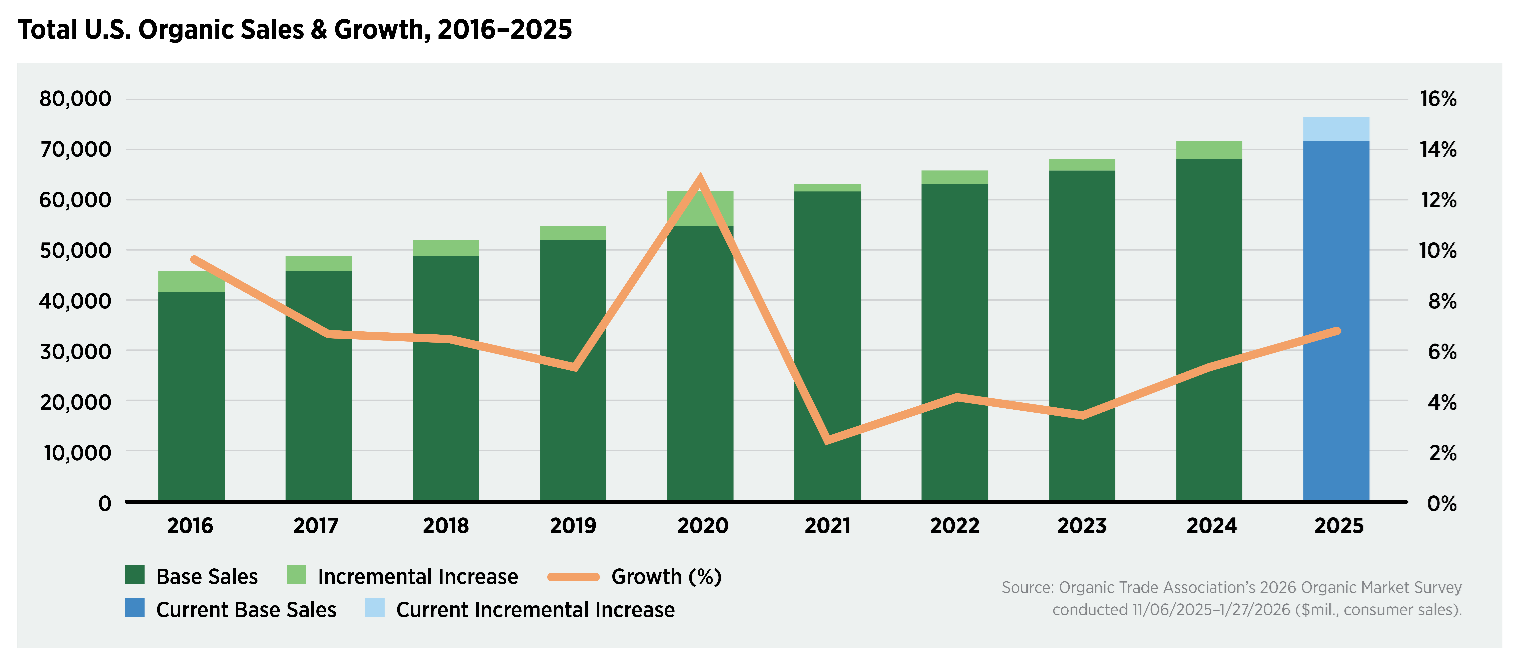
The organic marketplace continued to build strong momentum with organic food sales totaling $70.1 billion, a 6.1% penetration rate into the overall food market. This is an increase of 6.9% for the year with organic food growing three times as fast as the overall food market, which increased 2.3%. Organic textiles, dietary supplements, personal care, and pet food contributed $6.5 billion in sales, just under 1% of the total comparable market sales for these categories.
Sales were led by fresh produce, which still serves as the primary entry point for organic purchases. Sales of organic non-food products totaled $6.5 billion representing just under 1% of the overall comparable market sales for those categories.
Key trends that influenced purchases of organic in 2025 included desire for cleaner ingredients and formulation profiles, as consumers focus on their personal health and wellness. With continually shifting attitudes towards “food as medicine,” consumers increased their protein intake again in 2025, with products containing more protein showing up across categories from functional beverages to cereals to snacks.
Top organic sellers by product category:
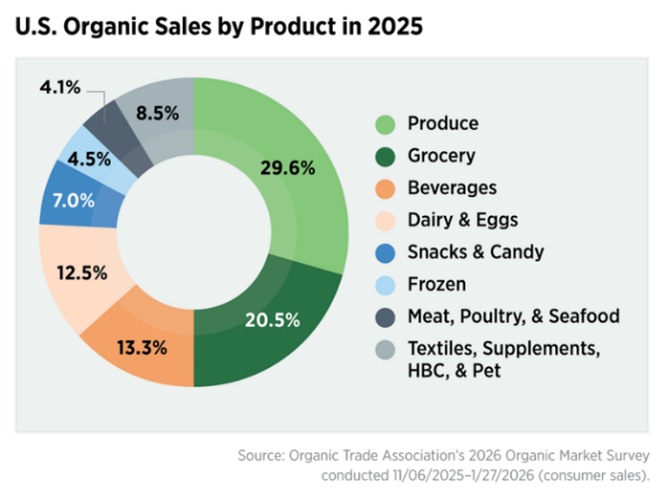 • At $22.7 billion, organic produce held its top spot as the standout category, accounting for nearly 30% of total organic sales with a steady growth rate of 5.3% for the year. Berries remain the hero of the organic produce category with sales rising to $4.4 billion, an increase of 10.5%. Citrus had a strong year, with sales climbing 18.1%, while bananas also experienced double-digit growth at 12.6% to reach the $1 billion mark.
• The second biggest-selling organic category was grocery, posting sales of $15.7 billion in 2025, achieving a steady 4.2% overall growth rate. Highlights of the year included ongoing growth in organic baby food and formula of 8.8%, now accounting for 11.0% of organic grocery sales. Dried beans, fruits, and vegetables grew at a healthy pace of 13.6%, driven by consumer demand for shelf stable products, correlating to consumer desire for healthy plant-based foods, clean eating and overall affordability.
Younger consumers, particularly Millennials and Gen Z, are also helping shape organic grocery sales trends by balancing health-conscious choices with quality and indulgence.
• As the third largest segment, organic beverages experienced 7.2% growth to reach $10.2 billion, driven by innovation to meet consumer demand for products focused on clean ingredients and drinkable nutrition. The category has also seen increased desire for products with functional performance and wellness benefits, reflected in the 11.5% growth of the soft drinks, enhanced drinks, and powders sub-category.
Other beverage segments with double-digit growth included dairy alternatives (18.2%), spirits, liquor & cocktails (16.6%), and shelf-stable juices and drinks (11.4%).
• In the fourth largest category, organic dairy and egg sales grew at a notably strong rate of 12.8% to reach $9.6 billion, a $1.1 billion increase from a year ago. Organic yogurt, the second largest subcategory in this segment, grew 16.6%, driven by the increasing consumer preference for clean, portable protein. Organic yogurt products for babies and kids also saw sales increases. Organic egg sales rose significantly at 22.4%, even as prices remain high due to the long-term impact of the Avian Influenza epidemic that began in 2024.
The growth in organic dairy and eggs aligns with the current health and wellness trend that is resonating with shoppers who are looking for high quality, nutrient-dense products even when priced at a premium.
• In poultry, meat, and seafood, the big story in 2025 was the growth in organic beef. Topping $1.4 billion in sales with an extraordinary growth rate of 44.3%, beef had the highest increase of any category for the year. While driven mainly by imports, efforts to grow domestic organic supply are in process with new products coming to market in 2026.
• Sales of organic textiles, personal care, and dietary supplements are growing in popularity as consumers learn more about the effects of pesticides and toxins on their health. Although these categories face strong competition from “natural” and “eco-friendly” products, they each grew in 2025, with organic textiles increasing at a rate of 5.8% to reach $2.7 billion. Organic supplement sales grew 8.7% to reach $2.4 billion and personal care products experienced a modest increase of 2.7% to reach $1.4 billion.
Organic remains a stand-out in a growing sea of labels
While the expansion of claims and labels in the retail aisles did not slow down in 2025, including growth of regenerative, the USDA Organic seal remained a constant source of trust and confidence with consumers. The research shows younger generations consider the impact of production on people, planet, and animals when making their purchase decisions, with an increased interest in transparency and sustainability. Yet research consistently shows that while consumers value all the attributes in organic, more education and visibility on organic attributes would help new consumers make the connection to all that USDA organic certification stands for.
“Organic has unique assets for growth, notably that the USDA Organic seal has strong consumer recognition and the highest level of trust in a certification,” says Matthew Dillon, Co-CEO of the Organic Trade Association. “With that in mind, we launched the ‘Seal Makes It Simple’ integrated marketing campaign in Sept. 2025 to deliver relatable, scientifically proven information about the benefits of organic and the power of the seal. The fact that the campaign has already exceeded our expectations tells us that consumers are hungry for credible information and that organic is capturing their attention and driving purchase, which is a win for everyone.”
Looking ahead
While political and economic conditions remain unpredictable, the organic sector enters the latter half of the decade facing both uncertainty and opportunity built on strong consumer demand, continued regulatory enforcement, ongoing public-private investment, collaboration and advocacy. With these drivers, organic agriculture is well positioned to remain a vital and growing part of the U.S. food system.
The long-term outlook for organic forecasts a compound annual growth rate (CAGR) of 5.6% which has remained consistent since 2016. There are positive indications that strong industry growth will continue with annual organic sales projected to increase another $24 billion over the next five years. Organic is expected to cross the $100 Billion threshold in 2030.
Methodology: Data compilation and industry model
The organic industry model was created using a variety of data sources that reflect sales data for the 2025 calendar year. Inputs that were included but are not limited to: point-of-sale data, expert interviews, annual report data, and survey data collected from November 6, 2025, through January 27, 2026.
Executive summaries of the 2026 OTA Organic Market Report are available to the media upon request. The report will be available in full as a benefit to OTA members. For non-members, the full report will be available for purchase at OTA.com starting March 18.
# # #
About the Organic Trade Association
The Organic Trade Association (OTA) is the membership-based business association for organic agriculture and products in North America. OTA is the leading voice for the organic trade in the United States, representing organic businesses and producers across the nation. Its members include growers, shippers, processors, certifiers, farmers' associations, distributors, importers, exporters, consultants, brands, retailers, and others. OTA's mission is to promote and protect organic with a unifying voice that serves and engages its diverse members from farm to marketplace. For more information visit OTA.com.